

21 Jul Discover the Benefits of Image Guided Injections
Over the last twenty years or so, there has been huge development in the use of various imaging modalities to assess and diagnose painful conditions of the spine and peripheral joints, muscles, and nerves. X-rays have been around for decades, and CT scans came into use in the 1970s and then in the 1980s following decades of physics research, MRI scans became available improving upon CT scans and without the radiation associated. Ultrasound came into regular use for diagnosis in the 1970s, but it is in the last 10 years or so that the imaging quality has improved to the point where it can challenge MRI in some areas.
Just as we have seen this explosion in diagnostic capability with these imaging modalities, we’ve also witnessed the increasing use of these imaging modalities for the purposes of guiding injections, to precisely deliver medicines.

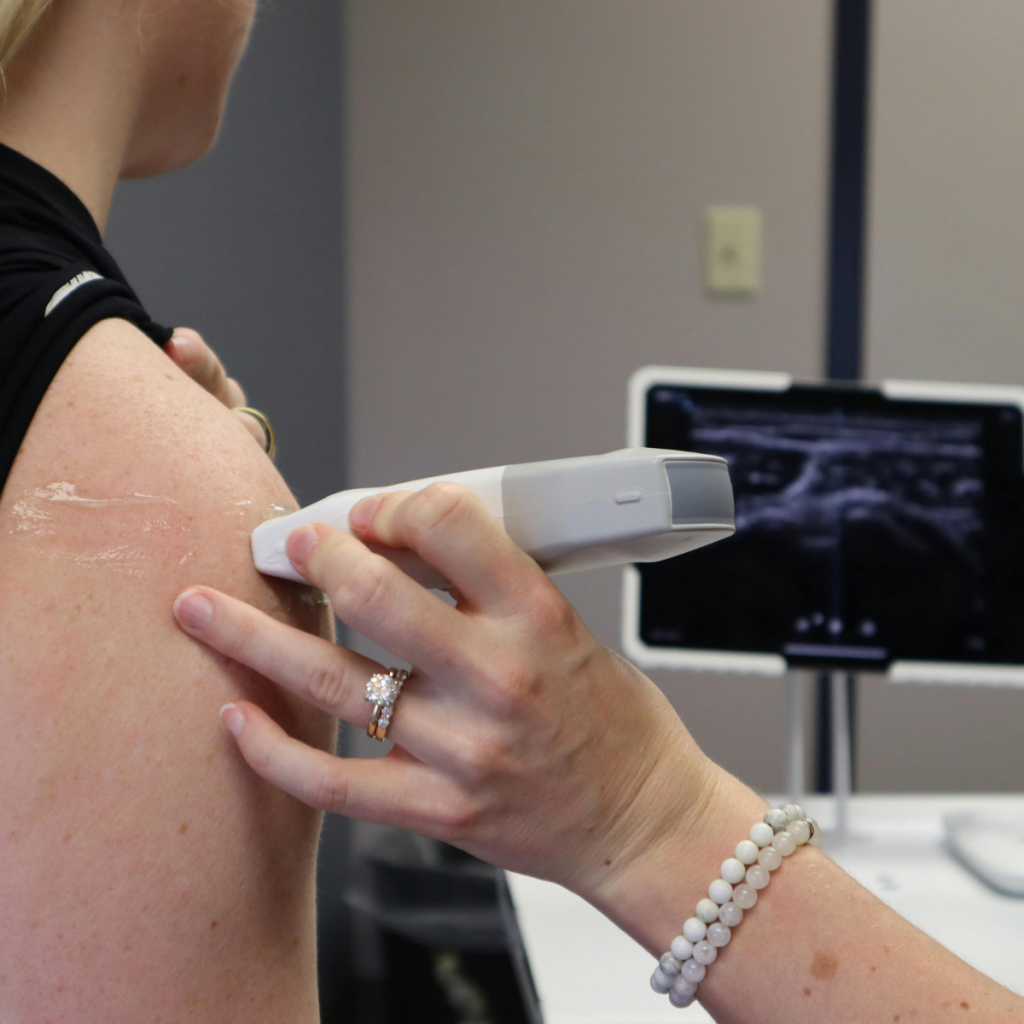
When I first began my early career in musculoskeletal medicine in the 1980s, we were very limited in what modalities we could use to perform injections. Mostly, these injections were guided by palpating nearby bony landmarks and approximating where the injection should go. For an experienced clinician, these so called “blinded injections” can be very successful for many common conditions. For deeper structures, however, it is much more accurate to use some form of image guidance. In the rooms here at Brighton Spine and Sports Clinic, we have been utilising ultrasound to help guide our injections for over ten years, and more recently have had a major upgrade in equipment, having purchased a SonoSite ST Point of Care ultrasound machine. This state of the art in portable ultrasound machines gives us high quality images and allows us to accurately place injections into some of the deeper joints such as the hip and shoulder, as well as having the detail to target many of the small nerves that can contribute to pain around joints such as the hip, knee, and ankle, without exposure to X-ray radiation.
We can now accurately measure the size of these nerves such as the median nerve at the wrist (commonly compressed in carpal tunnel syndrome). The ultrasound machine can then be used to accurately guide our needle placement for injections around some of these peripheral nerve structures.
Types of Conditions Treated with ultrasound guidance:
Ultrasound guided injections are versatile and can treat a variety of common medical problems, including;
- Osteoarthritis: This degenerative joint disease often causes pain and stiffness, especially in older adults. Most joints can be targeted with ultrasound
- Torn / damaged tendons and ligaments: these include Achilles tendinopathy, jumpers knee, tennis elbow and shoulder rotator cuff tears.
- Post-Surgical Pain: After surgical procedures, there can be local scar related pain and sensitivity which can be targeted with these precise injections.
- Bursitis: A condition marked by inflamed bursae around the hips and shoulders most commonly, causing discomfort when lying in bed. The injection reduces inflammation and pain.
- Peripheral neuropathy is a new area of research recently found to benefit from focal injections around the tiny nerves – only seen with ultrasound.
These injections are not just about reducing pain—they’re about enhancing life quality. By accurately delivering medicine where it’s needed most, guided injections help patients regain mobility and return to everyday activities.
What about X-Ray Guided Procedures?
Other modalities used for guiding injections include CT scan and C-arm fluoroscopy. These two techniques both utilise X-rays to outline the bones and are still required for many spinal injection procedures. Injections under CT guidance are performed by Dr Victor Wilk at Olympic Park Imaging in Richmond. The CT scanner has the advantage of providing reconstructed pictures that give you a 3D view of various parts of the body. This is particularly useful when performing certain spinal injection procedures. The depth and angle of the injection can be pre planned giving the operator exact measurements of the position of the needle required. Air or contrast dye is usually used to confirm the final position of the needle and spread of any fluid from the tip of the needle. It is important to confirm that the injected material has actually reached the intended target.
C-arm fluoroscopy is performed slightly differently. This is where the patient lies still on the table, and the C-arm X-ray machine moves around the patient while they lie still. C-arm fluoroscopy has the advantage of giving live pictures as you move the needle or inject dye into the patient, which gives a more accurate view of exactly where the injected material flows. This is particularly advantageous when performing epidural injections. Dr Victor Wilk performs injections under C-arm fluoroscopy at Holmesglen Hospital, Moorabbin. The one drawback of doing these procedures is that the patient needs to be admitted as a day case surgery patient as the procedure is performed in the operating theatre. The advantage of this is that it is a more sterile environment, and there is the option of having an anaesthetist to give a light or twilight type sedation anaesthetic.
The use of cortisone explained:
When inflammation is excessive or detrimental to the ongoing healing of tissues, then Cortisone may help. Cortisone medication may be given in tablets or by injection. The advantage of injections are that the anti-inflammatory effects are maximised at the site of the pain and inflammation with minimal general side-effects. Cortisone effects last about 6 weeks and can be a very effective circuit breaker in chronic pain as well as reducing joint swelling in inflammatory conditions like Rheumatoid arthritis and around nerves that have been compressed such as in Carpal tunnel syndrome and disc protrusion of the neck and low back.
Newer regenerative medicine approaches:
Platelet rich plasma (abbreviated PRP) is a new treatment used for some common orthopedic conditions. PRP is derived by taking your own blood and placing it is a centrifuge to separate out the red and white blood cells from the plasma and platelets. The remaining platelets and serum extracted contain high concentrations of specific growth factors that have been shown to promote healing in damaged tissues. By injecting PRP into areas of an injury, the hope is to stimulate and optimize your body’s ability to heal the chronic conditions.
Some of these growth factors are in the concentrated plasma and some are thought to be released by the platelets including; platelet-derived growth factor (PDGF), transforming growth factor beta (TGF-β), vascular e
ndothelial growth factor (VEGF), insulin-like growth factor 1 (IGF-1), and hepatocyte growth factor (HGF).
PRP has been used in operating rooms for several decades to help with wound healing, and to stimulate bone formation in spinal fusion surgery and dental implants. Increasingly over the last 10 years, PRP has been used in outpatient settings for treatment of common orthopaedic conditions including:
- Achilles Tendonitis and ankle sprains
- Rotator Cuff Tendonitis and tennis elbow
- Knee sprains and patellar tendonitis
- Osteoarthritis of hips, knees, ankles, wrists and elbows.
Other nerve ablation procedures:
For some patients tissue damage has gone past the point of healing, this is more apparent in the elderly population where arthritis has set in or in the case of failed spinal surgery. Rather that undergoing a major spinal fusion operation an alternative of ablating the nerves can block pain from the spinal nerves providing relief for 12 months or more at a time. Some patients are too frail or old to go through extensive surgery and post operation rehabilitation for 6 months. Instead the nerves delivering those pain signals can be blocked under ultrasound or X-ray guidance allowing a much quicker return to activity. Radiofrequency neurotomy of the spine can be a game changing procedure for those crippled with back pain.
Dr Victor Wilk and His Expertise
Dr Victor Wilk, a distinguished practitioner at the Brighton Spine and Sports Clinic, is renowned for his expertise in performing x-ray guided injections. With a dedication to excellence, Dr Wilk combines his extensive knowledge, qualifications, and compassionate approach to deliver exceptional patient care.
Minimally Invasive with Maximised Comfort:
Understanding the procedure’s minimally invasive nature can also ease concerns. Not all injections have to be painfull; with the help of pain medications, local anaesthetic creams, applying ice beforehand and the option of Nitrous oxide gas, injections in the rooms at Brighton can be made with minimal discomfort.
For those undergoing more invasive procedures or with needle phobia, sedation with the help of our anaesthetist is available at Holmesglen Hospital.
Is It Right for You?
If you’ve been putting up with pain for more than 3 months and you’ve already tried allied health therapies such as physiotherapy, osteopathy, myotherapy and chiropractic – but not seeing any improvement, then it might be time to see if something else might help.
Alternatively you may have been recommended to have surgery on your knee or spine and wondering if there is an alternative. Deciding on the best pain management strategy can be daunting. However, specific guided injections provide a focused, accurate, and effective option for those looking to step beyond traditional pain medications and exercises.
Do you wonder if this procedure might be the next step in your pain management journey? Consider speaking to a healthcare provider about whether x-ray guided injections could be your solution.
It is important to note that the specific interventions and strategies employed by any medical practitioner will depend on the individual’s unique needs. Each practitioner in a care team will work collaboratively with each other to provide comprehensive care and support for the individual.
If there is a part of your condition or injury that you are struggling to understand, be sure to seek clarification with your medical professional. None of the information in this article is a replacement for proper medical advice. Always seek advice from your trusted medical professional regarding your health and/or medical conditions.